VIKINGS: An Immersive Experience
02 · About the exhibition
Vienna
VIKINGS: An Immersive Experience opens on 23 September 2026 at the MARX HALLE in Vienna and runs until 10 January 2027. The production tells the story of King Ragnar Lodbrok and Queen Aslaug according to Norse saga tradition, beginning with the raid on Lindisfarne monastery in 793 - one of the best-documented events of the Viking Age.
In the sagas (notably in Saxo Grammaticus and the Ragnars saga loðbrókar), Ragnar Lodbrok is a legendary Viking king whose historical core is still debated; Aslaug appears in the Völsunga saga as the daughter of dragon-slayer Sigurd and the valkyrie Brynhild. The show translates this material as sensory storytelling rather than factual documentation - with scholarly oversight (see Critical take below).
MARX HALLE takes over the role that, until July 2026, Titanic: The Immersive Experience played in the same hall: a venue that has specialised in large international touring shows of this kind.
The roughly 90-minute walkthrough leads through four rooms. On entry, each visitor receives bone-conduction headphones and a smartphone that triggers the audio tracks automatically at each station - hands-free movement through the scenery, no button-pressing required.
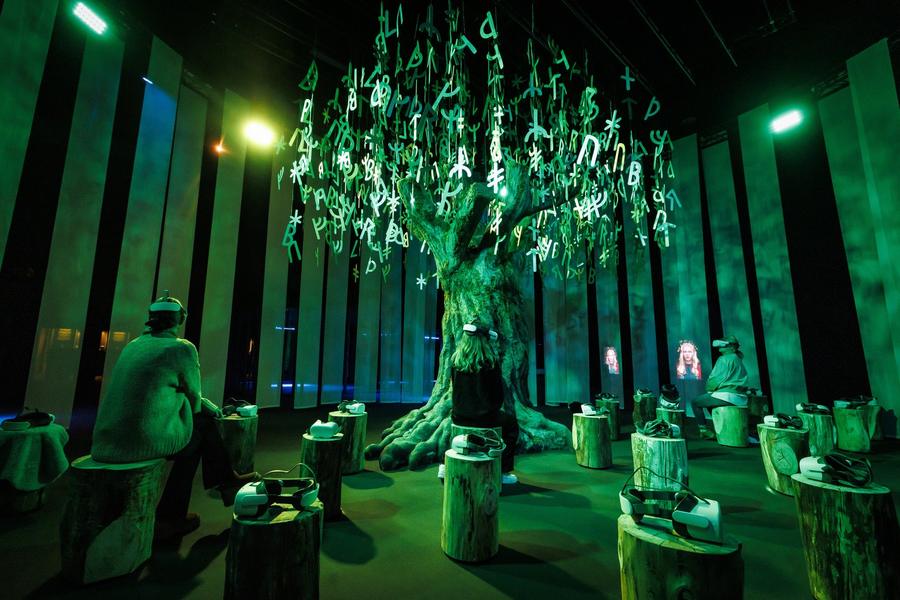
In the 'Forest of Time', mist and rune stones pull the group out of the present; in 'Yggdrasil', the World Tree, a VR sequence tells Aslaug's childhood and origins as a saga of its own - according to independent reviews, the most technically elaborate and cleanly produced part of the show. Between stations sit interactive touchscreens playing out historical Viking battles as time-lapses.
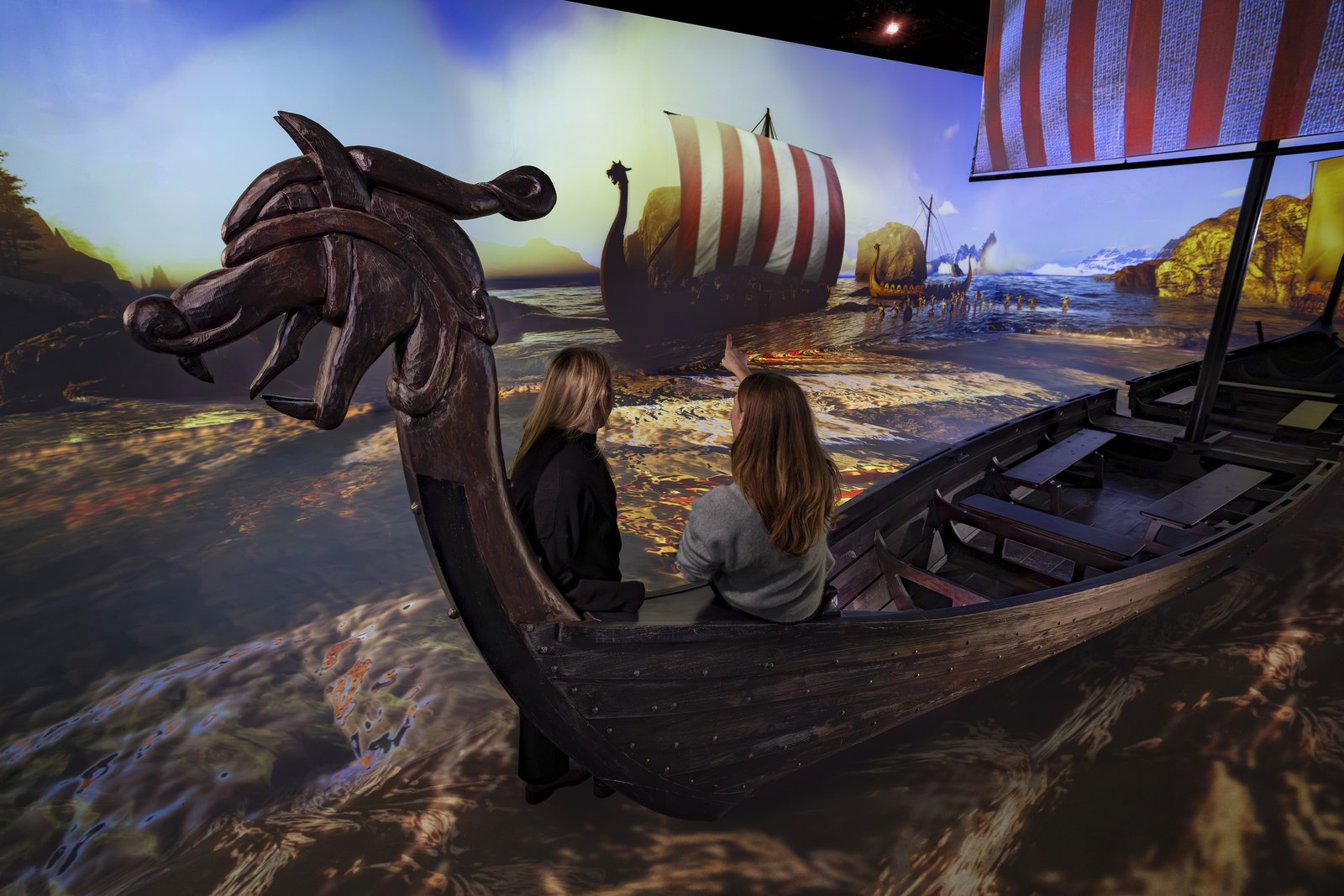
In the 'Cloud Room', orientation dissolves: mist fills the space, time and direction markers vanish, before the scenery opens onto the actual climax - the Longship. There, wall-to-wall projections, floor effects and a descending sail that itself becomes a projection surface take over, set to an orchestral score by Studio Kreuzberg with Ilja Coric.
The ship room in particular is considered the most intense moment of the show: some visitors report mild seasickness from the combination of motion effects, sound and projection - an effect the exhibition's own scientific advisor explicitly treats as a mark of quality (see Critical take).
The staging also includes AI-generated avatars visitors can talk to - an element reviews received noticeably more mixed than the rest of the production.
Behind the production
The show is produced by Alegria Exhibition under the creative direction of Mitch Sebastian: a British theatre director and choreographer with over 30 years on stage, who first performed at London's Palladium aged 17, appeared in twelve West End productions (including Cats, Les Misérables and Starlight Express), was artistic director of Kilworth House Theatre from 2005 to 2015, and won a BAFTA for the animated series Yoko! Jakamoto!
The show was developed by The Storytelling Company (TSC Originals), with offices in Amsterdam, Berlin, Charlotte, Munich and Zwaag. TSC art director Antonia Böhme sums up the staging's ambition this way: the first gasp should always come earlier than audiences expect, well before the big reveal at the end of the walkthrough.
Alegria Exhibition produces; FKP Scorpio Entertainment presented the UK run, while in Austria that role falls to the CreARTive Group - the same group that also operates the Immersive Center at Vienna's Danube Tower. Photo documentation of the Hamburg leg is by Morris Mac Matzen.
The tour began on 5 November 2025 in Hall 7 in Hamburg (until 1 February 2026), ran from 12 March to 29 June 2026 at Dock X, Canada Water, in London - marketed there as the largest immersive Viking experience ever built in the UK - and now reaches Vienna with the MARX HALLE run. The narrative stays the same at every stop; sets and rooms are rebuilt from scratch each time.
The production has since won Bronze for Spatial Design at the CreativePool Annual 2026, plus Gold for Set Design and Audiovisual, Silver for Immersive Experience and Bronze for Multisensory Experience at the Eventex Awards 2026.
More about this place
The MARX HALLE itself has a long history before the Vikings arrived: the building is the former cattle hall of Vienna's central livestock market, St. Marx, built in 1879-80 to designs by architect Rudolf Frey in wrought iron - celebrated at the time as a feat of engineering. It opened in January 1881 in the presence of Emperor Franz Joseph I.
Originally 224 by 175 metres and 17 metres high, the hall held 4,000 head of cattle, rising to 6,000 after an 1898 expansion; it operated continuously as a livestock market until 31 December 1997. Construction of the A23 city motorway shortened the hall to its current roughly 175 metres in 1980 and again in 2003.
The building has been under heritage protection since 1997; temporary event use began in 1999, and after a thorough renovation in 2006-07, regular operation as MARX HALLE has run since 2014, with the lease secured through 2084. The same building has housed Michael Niavarani and Georg Hoanzl's cabaret theatre Globe Wien since 2014.
Critical take
Scientific oversight comes from Viking scholar Prof. Dr. Rudolf Simek. His take: 'An immersive exhibition like this is something quite different from a factual one. It's about the experience - it works on the senses more than pure science does. I made sure we got the facts 99 percent right.' He explicitly treats the fact that some visitors feel mildly seasick in the ship room as a compliment to the production: 'I find that fascinating, and it speaks to the quality of this exhibition.'
Simek is more critical of the staging's use of artificial intelligence: 'For me there's almost too much AI in it,' though he acknowledges its value for reconstructions. That assessment lines up with independent reviews, which single out the AI-generated conversational avatars as 'cheap and soulless' - a noticeable step down from the VR sequence in Yggdrasil and the 360-degree projection room, both explicitly praised in the same reviews.
On the target audience, the verdict is consistent: reviews recommend the show above all to Viking enthusiasts, VR newcomers and families with children aged 10 to 15; anyone looking for original museum artefacts rather than staging is better served by a classic museum. Some adult visitors find the roughly 30-minute 360-degree section a little tedious.
- 23 September 2026 to 10 January 2027, MARX HALLE, Karl-Farkas-Gasse 19, 1030 Vienna.
- Getting there: U3 to Erdberg (Nottendorfer Gasse exit, approx. 5 min) or Schlachthausgasse (approx. 8 min), tram 71 to St. Marx or tram 18 to Viehmarktgasse.
- Sun-Wed 10:00-20:00, Thu-Sat 10:00-21:00; last admission before closing. Duration approx. 90 minutes.
- Tickets from EUR 25.90 via Fever, dynamic pricing up to around EUR 30 depending on time slot; free for children under 6.
- Scientific advisor: Prof. Dr. Rudolf Simek.
03 · Impressions
MARX HALLE

04 · Where to find it
Vienna
MARX HALLE
Karl-Farkas-Gasse 19, 1030 Wien
ticketing runs through Fever (https://feverup.com/m/528673); same producer family as the Titanic immersive show previously at MARX HALLE
Sources05 · More exhibitions